Showing posts with label cooking. Show all posts

2.06.2017

Back and Forth - A Photo Journal of Reveries


Juxtaposition on today

"Magic is just science we don’t understand yet.
 - Arthur C. Clarke

Containing Keys

 In creative work — creative work of all kinds — those who are the world’s working artists 
are not trying to help the world go around, but forward. Which is something altogether different 
from the ordinary. Such work does not refute the ordinary. 
It is, simply, something else. 
Its labor requires a different outlook — a different set of priorities."
 - Mary Oliver

An invitation

...and a gazing within


“At worst, ​one is in motion; and at best, 
Reaching no absolute, in which to rest, 
One is always nearer by not keeping still.”
 - Thom Gunn 


.


 “You can recognize a pioneer by the arrows in his back.”
- ​Beverly Rubic

Layers
Ravenwind Botanica Coriander Oil Infusing


"​Close some doors. 
Not because of pride, incapacity or arrogance, 
but simply because they no longer lead somewhere.”
​ - ​Paulo Coelho
Art supplies/animal findings

"But when I lean over the chasm of myself - 
it seems my God is dark
and like a web: a hundred roots
silently drinking.
This is the ferment I grow out of.
More I don't know, because my branches 
rest in deep silence, stirred only by the wind."
  - Rainer Maria Rilke

Slow Food - Nourishing Body and Soul (organic potatoes and healthy fat)

“Of all evil I deem you capable:  therefore I want good from you. 
Verily, I have often laughed at the weaklings 
who thought themselves good because they had no claws."
 - Friedrich Nietzsche

Calendula: Summer Bottled

The teacher who is indeed wise 
does not bid you to enter the house of his wisdom 
but rather leads you to the threshold of your mind." 
 - Kahlil Gibran 

 - and Gone Again

6.26.2016

Fast Food Fix the Slow Food Way: Curly Fries

I stopped eating fast food 20 years ago (that's right, drive thru's are not a part of my life), but I still get a hankerin' for some Curly Fries, so what's a gal to do?


I make them at home!  But using all organic materials, healthy fat:  extra-virgin olive oil, Himalayan sea salt, and this spice blend (all powders):


Cayenne 1 part
Onion 1 part
Garlic 1 part
Salt 2 parts
Turmeric 2 parts
Paprika 8 parts
Starch 24 parts

By parts, I mean any unit of measurement you choose.  If you choose teaspoons, you will have a total of 39 teaspoons of spice blend, or 13 Tablespoons since there are 3 teaspoons in a Tablespoon.  If you'd like more finished product than this, then enlarge your part, maybe a Tablespoon, or if you want to make a whole lot, maybe a 1/4 c.  You choose.  And you can eyeball the measuring if you wish, or add another spice you'd like to include...no rules.  This is kitchen alchemy not rocket science.  ;)

I like to make up more than I will use at once and keep it in a jar so it's ready to go for the next time.  Being an Herbalist I buy my spices by the pound as many I also utilize medicinally, and I simply use them often and in large quantities in my cooking.  :)

The starch can be any type, I have used Tapioca or a non-GMO corn starch.  This acts as a carrier and also provides a "coating" like "crust" on the fries.

I use a Spiralizer (also works great for all those Zucchini - I make Zucchini pasta - anyone who grows them knows what I mean), but you could just cut strips by hand.  Coat the cut potatoes and the baking sheet with olive oil (I just pour some on and use my hands to mix it all up), sprinkle with salt and the spice blend to taste and bake 400 degrees for about 40 minutes, turning at least once to get them evenly crispy.


Enjoy this healthy snack!  or even make it a meal - top with avocado and mix with some steamed Kale. 

I like to make a lot at a time and have leftovers; they're great on soup or in an omelette for instance...

4.07.2016

Breaking Fast with Some of Spring's Edible Wild Flowers


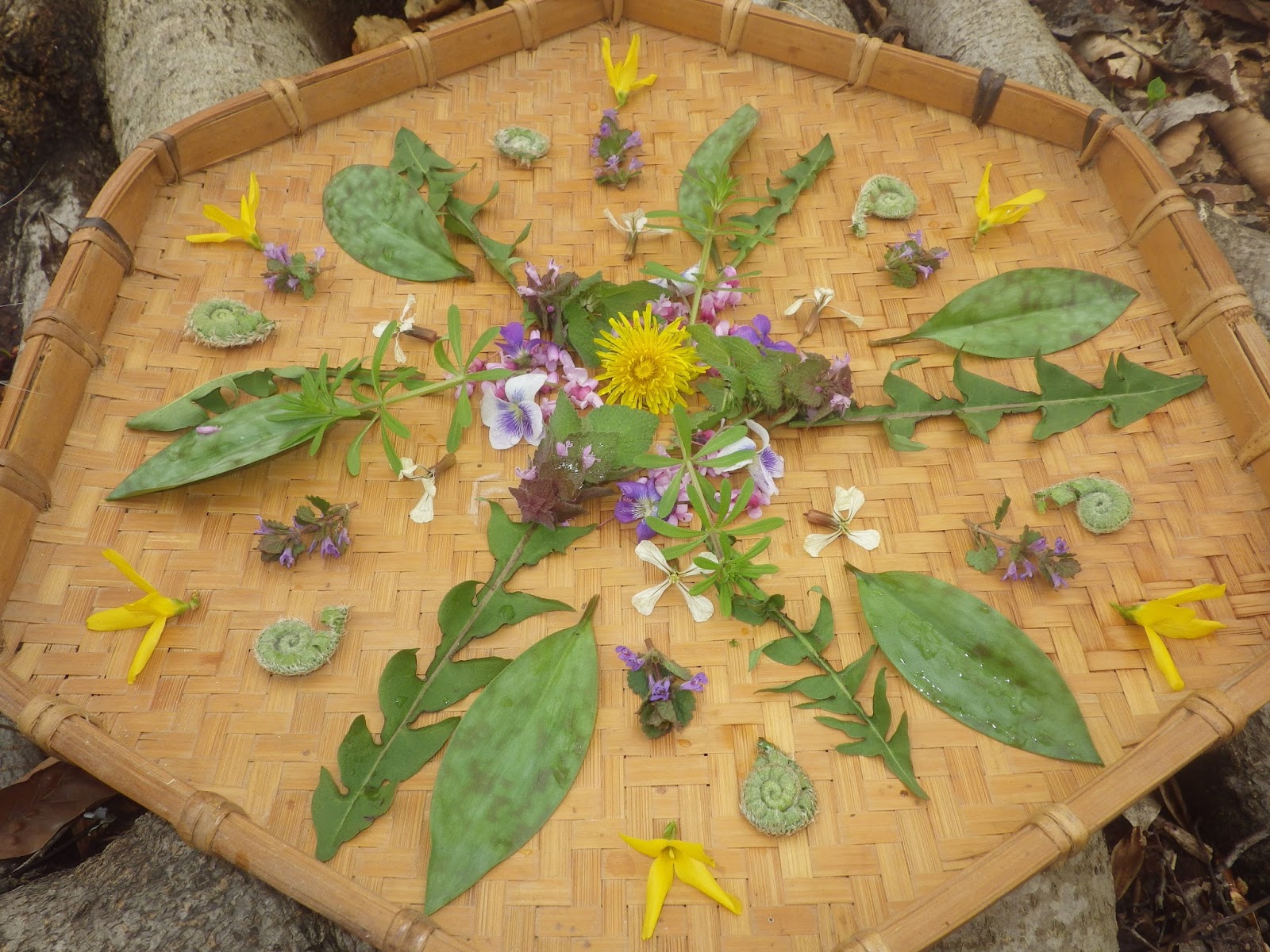
I took a walk this morning and gathered some wild edibles from the yard for a breakfast omelette.  I made some art while walking in the rain-wet wild, or should I say soothed my soul...


In this mandala, you will find mostly wild plants, one feral (Arugula flower), one horticultural (Forsythia flower).  The wildflowers are Ground Ivy, Purple Dead Nettle, 2 types of Violets, Dandelion, and Redbud.  The wildleaves are Cleavers, Dandelion, and Trout Lily with the spirals of fern fronds just beginning. 

Can you recognize them all?  If not, time to get out the field guides and go into the field, learn a plant a week...or a month and in a few years you will have a repertoire.   Make sure that part of your learning includes learning about the habitat and ecosystem you find the plants in and their role including whether they are invasive, rare, slow-growing, endangered, native, common, tenacious, etc.  You want to know *if* you should harvest and *how* to harvest if you do.  You'll want to know if there are poisonous look-alikes and how to tell them apart.  You'll want to know if you can only eat certain parts of the plant, or only eat it in certain seasons.  You'll want to know if the plant is an annual, biennial, or perennial as this affects harvesting guidelines.  You'll want to know if it has medicinal qualities and what they are, and so on...  Truly learn and study the plant before harvesting and eating a wild plant.


"The traveler has to knock at every alien door to come to his own, and one has to wander through all the outer worlds to reach the innermost shrine at the end." 
 - Rabindranath Tagore


I chopped up the bigger pieces and added some Garlic Mustard, see picture below.  This is one plant that you can freely harvest anytime and should actually pull it up by its roots and dispose of the roots in the trash if you do not eat them, not the compost.  It is one of the worst invasives that no amount of purposeful eradication seems to work, so you can't get rid of it even if you try, and I have tried for many years on my property as it crowds out natives and other less tenacious plants.  I still always have it, lots of it.  So harvest away.


I then mixed this with good eggs (good meaning not out of a battery cage like most eggs bought and sold) and cooked it in local lard from happy pigs and put this on sprouted, whole-grain bread with extra virgin olive oil and salt.  All organic, all ways.  Here's why.


It tastes fresh, green, vibrant, and alive! just like spring itself - a perfect way to start the day.                      
Plus you get to eat spirals.  :)


 “The moment one definitely commits oneself, then providence moves too. All sorts of things occur to help one that would never otherwise have occurred. A whole stream of events issues from the decision, raising in one’s favor all manner of unforeseen incidents and meetings and material assistance, which no man could have dreamed would have come his way.” – Goethe


4.15.2015

Japanese Knotweed - Lime Bars and Native Mason Bee Housing - A Primer on this Ubiquitous Weed


Japanese Knotweed


Japanese Knotweed Lime Bars


Japanese Knotweed utilized as part of a Mason Bee House

I just love utilizing invasive non-native plants.  I can feel good about harvesting them because I know it helps other plants that are native and/or not invasive by keeping down the growth and spread of the invasive AND I know I won't hurt the plant's ability to survive (try as I might). In some instances, like Garlic Mustard, you just can't eradicate it even if you want to.


Up Close

It's that time of year when Japanese Knotweed Polygonum cuspidatum sends up it's new stalks from the Earth.  These can be eaten like Asparagus, though they also work well in deserts, and have a lemony type flavor, as we shall see...
The roots are used medicinally and are called Hu Zhang in TCM; they have been used for an assortment of issues such as cancer, cystitis, Lyme, and traumatic injury (see a qualified practitioner for this).


To make this delectable desert:

Harvest the stalks before they have done much leafing out, remove any leaves and the very top where the leaves are forming (these can be added to an omelette or the like); chop the remaining stalks up into small pieces.  You want about 4 cups of chopped stalks, a little more or less is fine.

Leaves and tops to use for another dish.

Chopping into small pieces.

Splitting the larger ones lengthwise before chopping.


Preheat oven to 350.  For the bottom layer:  melt a stick of butter in an 8" x 8" pan, once melted mix directly in the pan with the butter:  one cup of whole wheat pastry flour and one cup of raw cane sugar.  I like to use all organic ingredients so I'm not ingesting pesticides or contributing to their being sprayed on farms and poisoning the water and land (along with the food).  Mash this dough evenly into the bottom of the pan covering the entire bottom.  Bake for 15 minutes. Allow to cool so it hardens.

The top layer mixed and ready to pour onto bottom layer.


In the meantime, make your top layer:  mix 3 eggs, 1 c. raw cane sugar, 1/2 c. whole wheat pastry flour, 1/4 c. lime (or lemon) juice until well blended then stir in the chopped stalks.  Pour this over the cooled bottom layer and spread evenly.  Bake one hour, turning oven to 400 for last 15 minutes.  Make sure the topping is set up; it might need a little longer cook time. 

Delish!

If you build it they will come:  the Mason Bee House on the art studio, L'Atelier.  Netting is to keep birds out.


A...n...d....  another use for those stalks after they die back in the fall (they persist through winter so you can harvest them right up into early Spring) is housing for Mason bees.  These solitary bees nest in tubes, whether that be hollow plant stalks, holes beetles have drilled in trees, or anything similar such as holes we drill or tubes we put out.  They live for 6 weeks in the Springtime right at the moment fruit trees bloom.   
***If you have fruit trees, you want these bees on your property.***  They are easy to care for and do a better job with fruit trees than honeybees because of how they gather nectar.


Drilling the starter holes in 7" pieces of Fir 4" x 4", then on to using a hand-held drill to finish them.

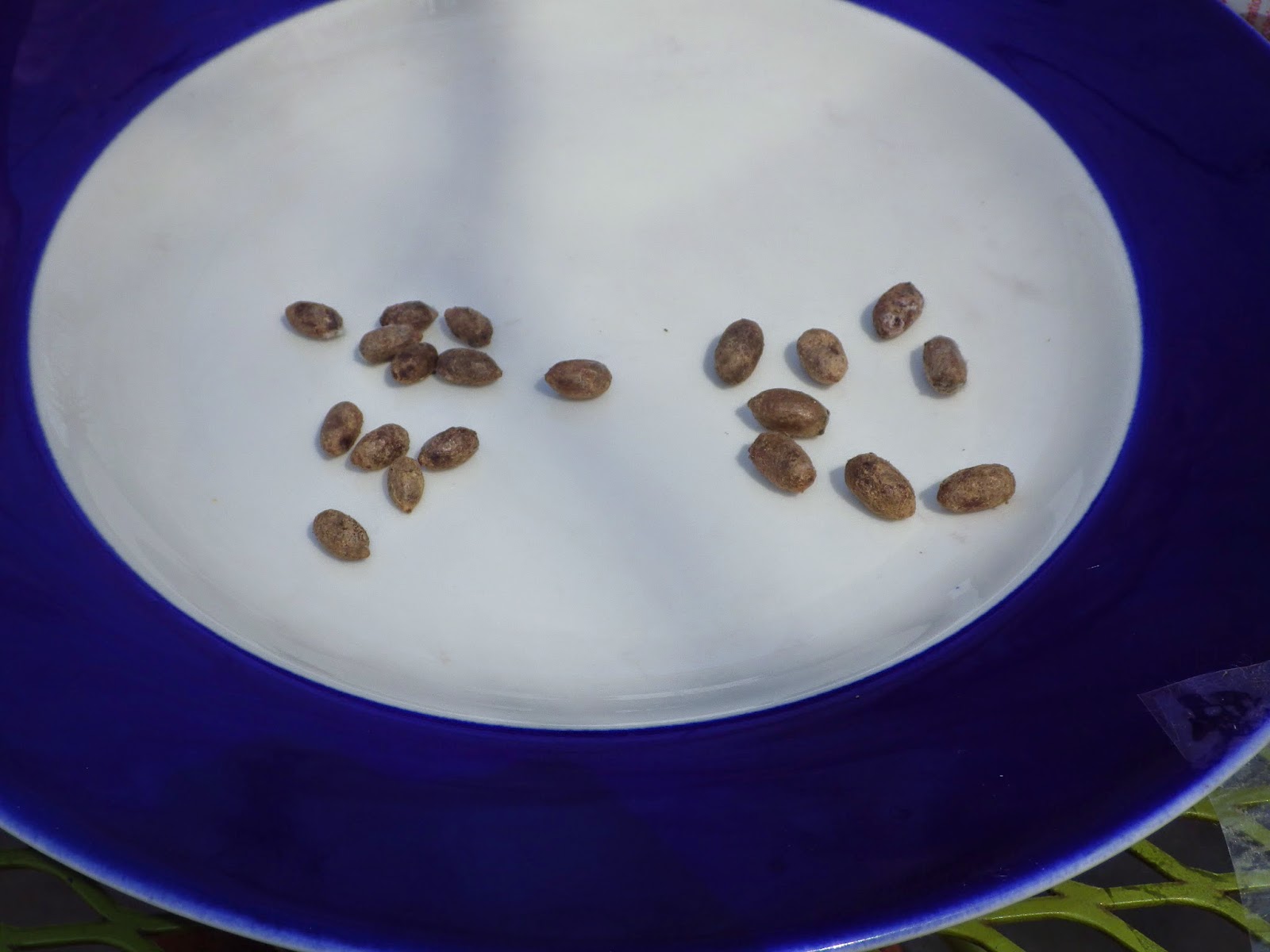
Mason bee cocoons gifted from a friend, thanks Laura!  Males on left, Females on right.

Mason Bee cocoon, they hatch from the nipple end, so this needs to face out if placed in a tube.


Here is a great book if you want to learn more.  Here is one of many houses you can purchase for them.
If you want to make your own, they prefer 5/16th size holes 6" deep (don't use pressure treated wood).  And of course, if you have access to a stand of Japanese Knotweed (bamboo also can work well), you can harvest your own as I did (seen collected in the 4 black pots in above picture of large Mason bee house).

A simple, smaller house can be made too, such as this one upper left.


~~~

1.26.2015

Going Nuts! - a Recipe: Gluten-free Nutella Crepes

Okay, so I just fixed a crazy good dessert and have to share it with you...


It's so good it'll make your skin turn inside out 
and your socks shoot off to the stars.

~~~
 If you think you can handle this decadent delight, here's how to make it for two:


For each crepe-type bottom mix one egg and about 1/4 c. hemp or other milk, whisk until frothy, and pour into a well-greased small skillet (I used about 1/2 Tbspn. coconut oil and a 6" cast-iron skillet).  You need to make sure it will flip and come out of the skillet in one piece, so no skimping on the fat.  Once lightly browned on both sides and cooked through place on a plate, then fix the next one.  While this is cooking chop about 1/4 c. of pecans.


Once your "crepes" are ready, spread each one with 2 Tbspn. of nutella (if you are lucky your grocery store will sell an organic, natural version of this hazelnut cocoa spread like mine does).  It's not easy to spread unless warmed - just do the best you can.  Top each with a half of a banana, sliced, then sprinkle on chopped pecans.  Best served warm.

This treat is high enough in calories to have it instead of a meal (about 500).  It's higher in protein and fiber than most desserts thought so you can feel good about it on occasion (about 12 and 3.5 grams, respectively).  I like too that it isn't made with flour.


I'd say Enjoy! but that would be superfluous.  :)


11.27.2014

Elderberry Syrup - A Method and Discussion

From this beautiful bouquet of a flower comes the berry...

 Great as a healing treat or a culinary delicacy!


This medicinal syrup is often thought of as being invaluable to the onset of colds and flu, particularly with fever, as it cools and promotes sweating, opening the pores and releasing the"evils" (as would be said in TCM).  I use this syrup for this, but also for some lesser known therapeutics:  nerve damage and pain (acute or chronic), constipation, and food poisoning.  And it tastes great...one of the easier herbs with which to gain compliance.  :)

Return of the Jedi in my oven.  :)

There are different ways of making this syrup and lots of possibilities of herbs to add.  In this batch I added Pine needles  (Pinus virginiana) my apprentices and I wild-harvested and processed.  This time I did not have fresh berries (was traveling when they were ripe here in Virginia), I used organic sugar for the syrup (you can also use glycerin), and I strained it.  Sometimes I leave it chunky for all the added goodness of the skin and seeds, but felt with the Pine needles included, straining would be good.  Plus peeps seem to prefer the syrup smooth.  ;)  Mind you if you leave the seeds in, you must cook it thoroughly as they can be toxic if uncooked.


Here's how to do this yourself:

(or inquire if you want to purchase or barter from me)

You will need:
1 lb. dry Elderberries 
(see link for Mountain Rose to right side to order)
about 7 c. organic raw sugar
any other herbs you wish to infuse, 
I used about 1 c. of Pine needles
canning jars or other containers

Begin by reconstituting your berries:  bring 8 c. of water to a boil, pour over berries and other herbs, let them sit steeping with a lid for a half hour.  Next hand mash or use a stick blender to break up berries being careful not to break up seeds (they won't hurt you, just taste bitter)Then strain.  I used a cheese press for this, but you could use a mesh bag or the like.  Put this liquid in a large pot with the sugar. 

If you aren't making a divine mess in the kitchen, you aren't doing it right.  ;)

Boil, stirring regularly until it's frothy.  Have your canning jars ready (warmed so they don't break), lids off.  Once frothy, pour the syrup into the jars and put the lids on.  As they cool, they will pop.  You can store these jars unopened a year out of the fridge.  I like to keep it in the fridge once I open it.

Getting frothy.

The marc, or leftover herbs after pressing, can then be composted or used for something else.  As I said, I usually don't strain my syrup and this is why.  This seems like a waste of good nutrients and fiber.  Normally I would utilize this marc, at least as a filler, in muffins or bars.  Or use it externally as a poultice even.  But being swamped for time and, after an apprentice day of remedy prep, loaded up on various marcs that I want to get the last bit of magic out of, let's just say the raccoons will be pooping purple!


I think next time I want to add something like Pine needles, I will infuse them first, strain, and then use that infusion to reconstitute the berries.  Live and learn, always something new to learn, especially when you constantly experiment and rarely do the same thing twice.  :)


I doubled the recipe.  One recipe makes (12) 8 oz. jars. 

Inquire if you want to purchase or barter, $15 for an 8oz. jar.*
All Organic.  Shipping is expensive for liquids and this weight, 
so best if you know me and can get it in person, but I will ship, inquire...

Elderberry Abstract Art

*If you are buying several Ravenwind Botanica products at one time, whether the same item or not, you can save substantially on shipping as I will ship it all together, please inquire and we'll get the payment set up right for you.  :)  You can click on 'Ravenwind Botanica' in the list to the right to see all products available.  Thanks for supporting my work.

11.02.2014

Flower Power: An Edible Flower as Medicine


Are you spellbound yet?


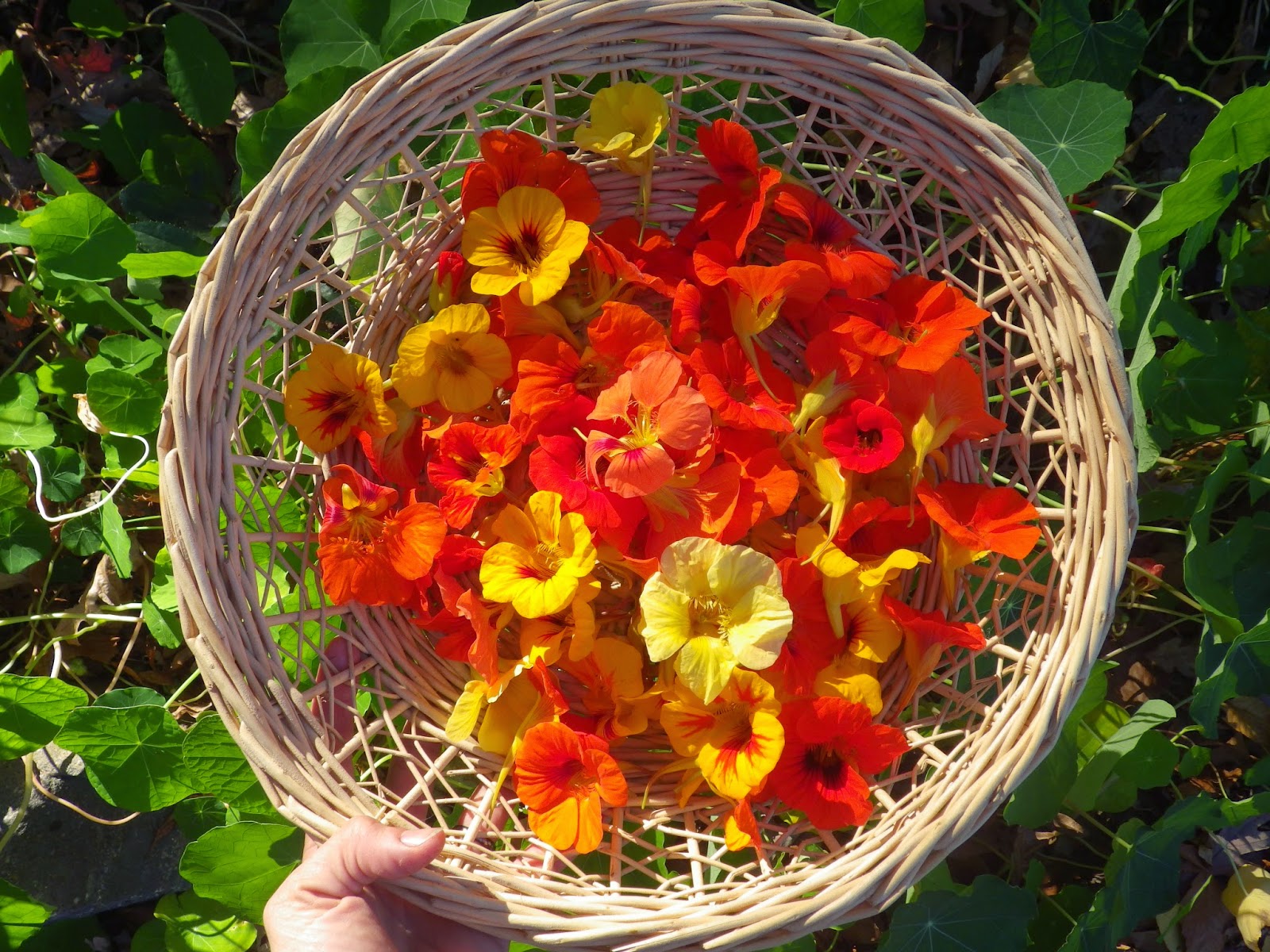
Nasturtium is the very definition of piquant:  
ˈpēkənt,ˈpēkänt/
adjective
 1.  having a pleasantly sharp taste or appetizing flavor.
 2. pleasantly stimulating or exciting to the mind.


Gotta love that, right?  right.


Why hello there.


This gorgeous flower is one of those I grew up with as a child; one of my favorite Aunts grew Nasturtium and they remind me of her and the wondrous time spent at her house.  I get extra delight now seeing that it also makes the hummingbirds and honey bees happy in my garden.  They both visit the flowers regularly.

An unusual site in November; an opportunity within the crisis of global warming.


We are having a late frost here in the Blue Ridge Mountains of Virginia, but it's expected tonight so I am harvesting the Nasturtium flowers before they get blasted by the cold.  Being a native to South America; they cannot tolerate frost, but they will grow all summer long gracing us with their presence - and their food and medicine.  Both the flowers and leaves are edible; both give a spiciness to the dishes they accompany.

Sunshine captured in a basket.

They are also anti-bacterial and can be used medicinally.  I have read of them being used for colds, flu, urinary tract infections, etc.  I am going to tincture them to experiment with this use...  I will do a vinegar tincture so it may easily be used in cooking and on salads.


To do this I will cover the flowers with vinegar in a jar, making sure all the flowers are submerged.  Next I will wait 2-4 weeks, shaking the jar daily, and then strain for use.  It can be used for cooking or taken by the teaspoonful as needed - or as wanted for its flavor!


I used wax paper under the jar lid so the vinegar doesn't react with it.


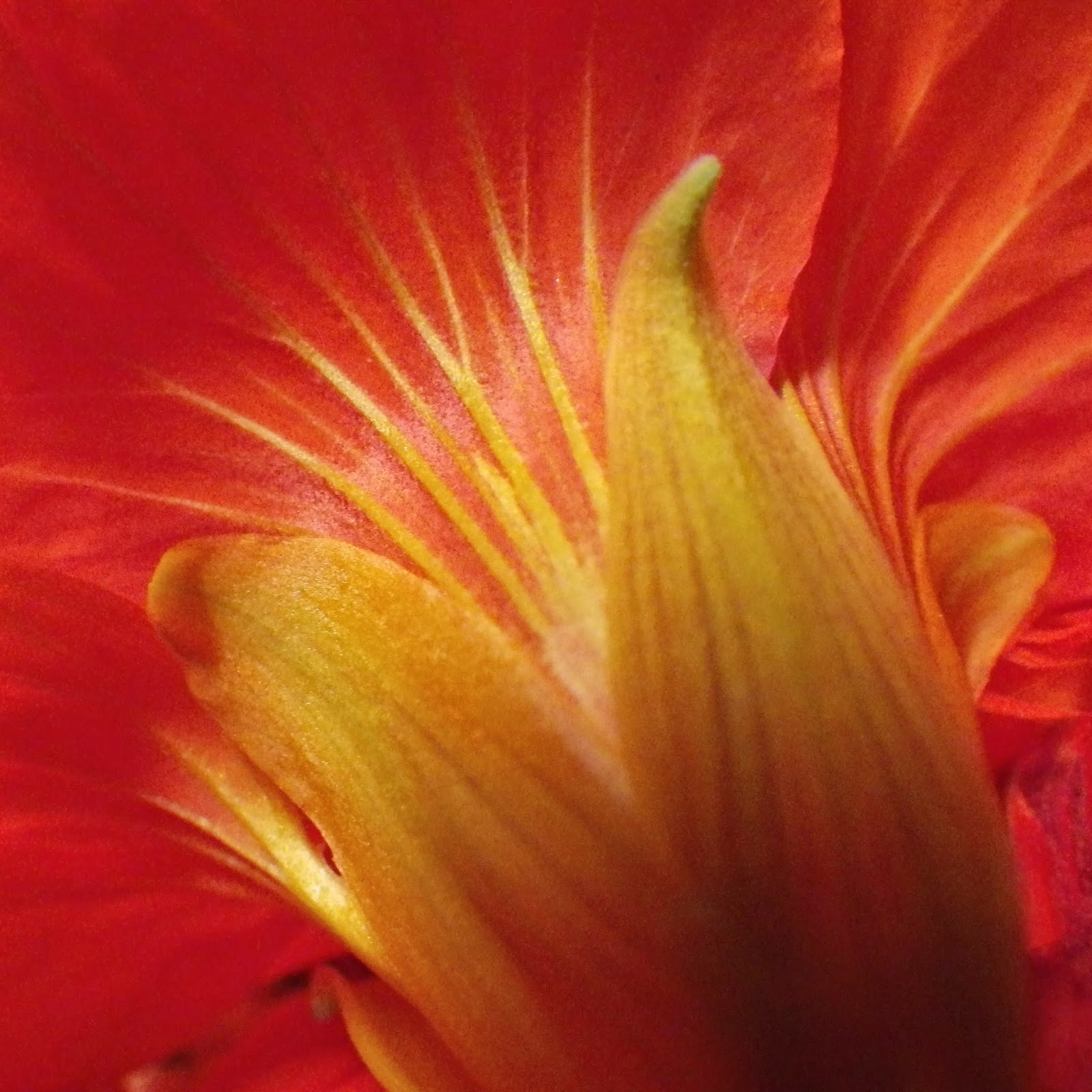
Update:  4 days later, I had to share with you this gorgeous color!

Oh, and no frost yet.
~~~